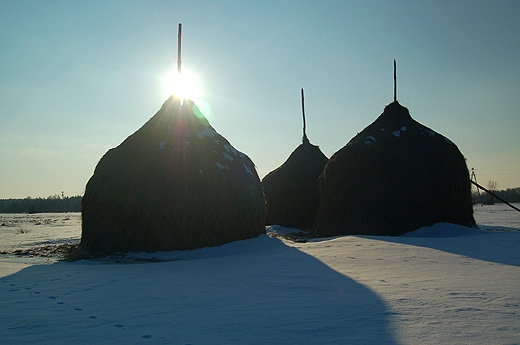
An older English name for this type of structure is a hayrick. In order to monitor the moisture content of the hay it would be tested by poking an iron rod — the proverbial needle — deep into the rick then pulling it out again, much like an oil dipstick in a car engine.
If you push the needle in too far then you would be unlikely to find it again without taking the whole thing apart.
Hence the English phrase like looking for a needle in a haystack to mean searching for something that is impossible to find. It’s just that in the original phrase the needle is a four foot long iron rod rather than a two inch steel pin.
"the English phrase like looking for a needle in a haystack"
That's not that (particularily) English, you know? As many other expressions that crossed cultures at some point, which (in some cases like this it would) most likely have taken place even before ethnogenesis of what's currently considered English, "the needle in the haystack" has a much broader spread.
I would love to hear of analogues from other cultures. Brewer’s Phrase & Fable 14th edition (the pink one) came up with this:
“To look for a needle in a bottle of hay”, after the french botte for ‘bundle’.
On the odd use of bottle: [Puck, to Titania] I could munch your good dry oats, methinks I have a great desire to a bottle of hay: good hay, sweet hay, hath no fellow.
Interestingly, haywire is derived from a frenzied behaviour likened to the chaotic uncoiling of a feel of hay baling wire.
the meaning is slightly different, the first is more about describing something vane, the latter is more about describing something very, very difficult or nearly impossible but that by luck or some other reason actually happened.
For the record, I believe there is very little typically Romanian in that way of making haystacks, many, many years ago (before the machines came) haystacks in Italy were made with the same techniques, maybe they actually date back to theRomans.
> I would love to hear of analogues from other cultures.
In German it's pretty much just the literal translation of the English phrase and its variations: "(Wie) die Nadel im Heuhaufen suchen" - (like) looking for the needle in the haystack, etc.
It's the same in Spanish, I'm surprised how universal this concept has become, even with people that have never understood what needles have to do with haystacks.
"Como buscar/hallar una aguja en un pajar" (like looking for/finding a needle in a haystack) means taking/achieving a nearly impossible task.
I mean it is in English, so it is quite English. Yes the idiom may be common in other cultures and languages, but that would be e.g 'the Romanian phrase {Romanian language equivalent of the phrase}'
It is not implying ownership of the idiom to the English language, just that specific phrasing. Which I think we can both agree is in English, and it is a phrase.
Reminded me of my childhood in Serbia, western neighbour of Romania, where we used to have same hay stacks [1], but now those are very hard to see, since modern methods prevailed for hay collection and transportation.
Not sure tbh, why this thing is called Romanian in first place.
Well now that I know, I think you should pay a licence fee for using our intellectual property. Please take an appointment to the Romanian embassy in Belgrade. Your money will help us develop even more the haystack technique.
I remember building those on my grandma's farm ~30 years ago. The adults woud throw hay to the top and us children would pack it down by walking on it in circles around the pole.
Another thing she would store for the winter were whole corn plant stems, arranged in a teepee-like structure around a tree trunk. The empty space between the trunk and the corn made a favorite hiding place for both us the children, as well as her chickens.
While reading the article, I was also wondering if this particular type of haystack is really uniquely Romanian. Although nowadays you have a much greater chance of seeing these in Romania, where there is a lot of hilly/montainous terrain which is not suited to the mechanical contraptions that spit out hay rolls (plus arguably in Romania there are more poor farmers who can't afford mechanical contraptions for their hay, or have plots so small that using a mechanical contraption is not worth it).
These are not unique to Europe either. We have these all over Nepal as well. It's still the dominate method for storing hay. In fact, I don't think I've ever seen a "modern" haystack!
Reminds me of my summer holidays which I spend on my grandparents' farm in Bosnia. It was so boring there, that I welcomed the manual and hard work on the fields.
Very nice pictures; reminds me of Claude Monet's "Haystacks".
> Haystacks like this are found nowhere else on earth.
There is no need to sensationalize. This is not unique to Romania.
Just search for pictures with "haystacks in eastern europe". First hit is from Glojene, Bulgaria; next from Valbone Valley National Park, Albania.
I'd be tempted to say that what article describes is THE way to stack grass for drying, no matter where you are, because it's based on common sense.
Wooden frames with cross-braces so that air can somewhat circulate within the construction and help it dry, keep the first level somewhat off the ground because that's where most of the moisture is, comb the result to align surface level straws vertically, so that any rain runs off.
I helped make plenty of these accursed things during childhood/early teens summers in Latvian countryside. Mind-numbingly boring for a kid, with added benefit of sunburn and insect bites. The only major difference was that no one would climb on top of them, we'd build them only as high as the pitchforks would reach from the ground.
Now I'm curious, is there any place in world that does (did?) their hay stacking in a radically different fashion?
I've never seen anything like it in Switzerland (and neighboring countries). From what I saw, the process here seems to be: first, let the hay dry on the ground by itself for a bit, then group it along "rows" that make essentially a stripe pattern on the field, and then make hay "balls" or "bricks" out of that. But maybe that's only because I've never seen anyone do it the old way?
In Norway "hesjing" was common until I grew up but of course I grew up in the 60ies and 70ies although I am born in 1980 ;-)
Hesjing means to create long temporary fence-like structures and then lifting the gross onto it.
If done correctly so the water can easily run off it can then survive a rainfall or two unlike what happens if you dry it flat.
This was actually important ant least in costal climates back before motorized fans made drying it indoors an alternative.
(Brings me back, woke up from the huge fan many days in the summer holiday. I also remember learning to start it, there was a delta/y switcher on it but I have now forgotten which configuration was for spinning it up and which was for steady state.)
Eh, the easy way to do this is not stack it but to store the hay under roof once it is sufficiently dry. Then you get a lot less waste and it is also more easily mechanized.
South Indian haystacks look very similar to these. In fact, in my childhood, I used to classify them as circular and squarish - these referred to the bases - with appropriately shaped tops.
Indeed, as someone who grew up in a South Indian city (Mangalore), my parents would send me off to stay with my agrarian relatives in the countryside during summer holidays, and haystacks like this were all over the place. Fast forward a few decades and I've seen conspicuously similar haystacks in Romania.
Looking at Monet's paintings (mentioned in another comment) it seems to me that haystacks were similar in France (and thus probably throughout Europe). I'm guessing that what's happened is that agriculture in Western Europe is fully mechanised now so these 'handmade' haystacks no longer exist there.
Are the stacks more then 4m tall and you build them with someone on top , while someone else lifts the hey with a long fork? I am curious if are similar or smaller in dimensions.
yeah, it can be higher, You have no choice then to use a long tool to raise the hey as high.
The funny coincidence is that I am from Romania and I just helped my grandfather with raising the hay on the haystack yesterday evening but we started a new stack so we are not at the top yet.
It's interesting how solutions to basic problems like storing hay can become markers of cultural identity. In Slovenia, kozolec hayracks are permanent structures that have evolved beyond being purely functional into elaborate works of art:
There is a Romanian Hungarian artist named Ernő Bartha who executed many hay sculptures. He has a park and holds workshops and camps. The site is in Romanian only:
In Norway they used to put hay on metal wires, tied to high poles, making a fence of hay that dries quickly in the sun. Then the dry hay was stored indoors in hay silos for the winter, usually with formic acid to keep it from rotting. I suspect this was the norm through-out Scandinavia. You only rarely see these long lines of hay today. Instead hay-bales rolled in white plastic are now the norm, sometimes humorously called tractor eggs... Anyway, whenever I see a farm doing it the old way, I make sure to take a photo. I had a lot of fun playing around in the hay when I was a kid, running under those posts and climbing them, and doing all kinds of shenanigans.
Lots of "arts" are fading away quick in Romania. Young generation is more interested in TikTok and other social media platforms than haystacks or cheese.
Looking at those pictures brings back happy childhood memories.
Hah, I literally helped make these as a kid! My family has a cabin in the Carpathians that would often serve as our summer vacation destination. The people are hardworking, tough, and stoic. It feels like lifetimes ago (we immigrated to the States in '97).
I was in the Carpathians 3 years ago for vacation. I remember being amazed that they still built haystacks and used scythes all over the place. Truly a gift for an American to witness.
Scything for instance is very labor intensive and it used to be payed like 3X hoeing, but we usually did it only once a year (you can cut the grass multiple time to produce a different kind of grass) as opposed to hoeing the corn, and I would prefer scything/hay gathering any time over hoeing :) .
Everybody I know that did scything has very fond memories of it, while no one that did hoeing the corn remembers it fondly.
I guess scything/hay gathering has a leisure aspect to it and you feel more connected to nature.
Also you feel incredible at the end of the day, because after the first 30 minutes of scything, you feel like you're going to die (all the glycogen exhausted from your muscles), you feel like you've hit a wall, but then you break that wall, slow your pace, eat your frustration and enter a flow-like state with your mind completely empty and then BAM the sun has set and you've made it through the day.
I haven't done it out of need, so maybe I have better memories of it than I should but it was a very skill-heavy activity where doing it poorly was frustrating and tiring, and doing it well was effortless and produced fantastic results. My favorite memory is one summer learning from a few adults, who weren't best at it, didn't have very well tuned or sharpened scythes, and then my grandfather coming out with his age-worn scythe whose blade was half as wide as the others' due to years of sharpening and fit him like a glove. He proceeded to completely out-scythe the guys, kinda like an elderly pro golfer. He would carry around a wooden water container on a belt, that held a stick with a piece of sponge on top and a sharpening stone. Every now and then he would break to wet and sharpen the blade. I remember it being scary how close he'd get to the blade while sharpening it, but still he'd do it quite often, almost after every row.
I miss that old communal, village lifestyle. Being financially unsustainable basically killed it, driving young people out after better work. Could probably do it again now that WFH is more accepted, and/or boutique farms and tourist income may provide some support.
Yes, doing it poorly is exactly like that, I did it poorly every morning for 30 minutes out of rage, and then did it masterfully until dusk -- I only developed the skills out of necessity.
Once you've wasted your anaerobic resources, you have to do it skillfully, but I would not call it effortless, not for me, it was just something that with enough willpower and teeth grinding I could do for hours upon hours.
Woah, so that's what they are. Whenever I'm visiting the countryside and I ask younger Romanians what those mounds are, they have no idea. I thought maybe it was for storing plum alcohol.
These are known all over the world. Not sure why they are called 'Romanian' now. It's like people just make things up and call it 'country' + whatever and that's it. Next step is to register them as EU 'heritage'.
Not very usual here in Norway anymore but I think I remember hearing about them as a kid growing up on a farm and I also found some pictures with the Norwegian name "høystakk" that seems to look very similar: https://duckduckgo.com/?q=h%C3%B8ystakk&t=fpas&iar=images&ia...
Edit, some more cool pictures describing other options like "såte" and the Sami "såte" equivalent, text in Norwegian though: https://slaattekurs.no/Kapittel7.html
Great article. I didn't get the point of the long central poles - seems that would assist water trickling in, and increase probability of lightning strike; they looked deliberately high.
Good question. The central pole acts like a kind of skewer. It keeps the hay from sliding off the top and falling over. As to the height of it, having something to keep your balance on top of the stack is essential. One of the photos shows the person standing on the stack and their head is at about the same height as the pole.
WOW! Follow the link of the OP and see a lot of colorful Romanian culture!
So, they make haystacks to feed the livestock in the winter. Yup, that is a near universal need for any farming with animals, that is, a near universal foundation of the economy of the world.
Sooo, also in the US, we have to harvest and store hay for the winter. So, now I remember: As a child, late one summer our family took a vacation and visited the area where Dad grew up, in the small town of West Valley, NY, a little south of Buffalo, NY. Dad's family didn't farm: His father owned the West Valley general store, and his step father owned the West Valley feed and grain mill. But one of Dad's childhood friends ran a dairy farm, and I got to visit, right, just as they were "making hay while the sun shined".
So, I rode in the wagon back to the barn: Now the situation is different from Romania and a lot more from Europe can see with a simple Google search. The barn was, yes, for the animals. But the barn had a second floor, the hay loft -- right, another solution to the same problem as the Romanian haystacks.
The hayloft was a large flat area, a whole second floor. At one end of the barn, there was an opening in the side wall. And there was a pulley centered in the opening, maybe 8' above the floor of the hayloft, and maybe 4' outside of the end wall of the barn.
Now want to move the hay to the hayloft, a way to store the hay for the winter and an alternative to the Romanian haystacks. So, grab maybe 200 pounds of the hay with some curved steel fingers like a hand grabbing a lot of spinach, run a rope from the top of the fingers to the pulley and from the pulley to a heavy horse, have the horse walk slowly and pull on the rope, and, thus, move the hay up to the opening on the side of the barn. Then pull the hay into the hayloft of the barn. For more, there can be a trolley system that will move the hay well into the barn and let it fall onto the floor of the hayloft.
So, right, "make hay while the sun shines" so that avoid the hay being wet and rotting -- same problem the Romanian haystacks solved.
Another step in handling hay can be to make hay bails. Some hay bails are cylinders maybe 6' in diameter and 5' high. Maybe a more common hay bail is rectangular -- there is a really good video of making such hay bails in
At one point the video shows that the hay bails are held together with wire. That would be the universal repair material, along with chewing gum, called bailing wire.
Now I more fully understand what I saw in that West Valley vacation when I was a child!
To continue, following the URL of the OP here, can see a lot of Romanian farm houses. They don't look like they have Internet, TV, telephone, or electric power.
Not so long ago in the US: When my future wife invited me to her home, they had a working farm. In one respect, they were modern in that both parents had college educations. But they had no cable TV, and their telephone was only on a party line. The area had only recently gotten electric power. Since then that area has become fully modern.
It does appear that in technology (A) in some ways within a few decades US farming areas were only a few decades ahead of Romanian farming areas but (B) in the last few decades the US farming areas have moved ahead much faster than the Romanian ones.
Then, it is not clear that the US farming area people are happier than the Romanian ones!
I would like to say, having lived in villages very similar to these in Transilvania, Romanian farm houses absolutely have internet, smart phones and internet.
WOW. Thanks. The images I saw showed the houses as nearly all log cabins where the logs were not painted, and I didn't see anything that looked like electric power lines. Can get Internet from just cell phones although of course need a source of electric power to charge the smartphones.
Maybe those areas of Europe are catching up, in the technology that is worth having, with England, the US, etc. I wish them well and hope so.
This looks more like the traditional poor peasant's houses (photos from 1933) and they're made of mud bricks (not sure what the english term actually is) with some wood reinforcement in the walls.
Store the silage in silos or on the ground covered with plastic.
Scale is nicely large: In total for the one farm, to store on the ground, cover an area maybe the size of a football field, 100 yards by 40 yards, maybe 10 feet deep.
All of that is in productivity per person way above what I saw as a child or young adult in visits to US farms.
I just followed the URL given in this thread and commented on what I saw in LOTS, dozens, of pictures and compared with some of what I know about how the US has solved the problem of gathering and safely storing summer hay for winter animal feed.
In the URLs I followed, nearly all the houses I saw were what in the US are called log cabins and had old logs and no paint.
I didn't see any "mud bricks".
From what I saw, there was no sign of electric power. Thus there would be no "land line" telephones either; from that I concluded no "telephones" -- I didn't think of the old satellite phones, cell phones, or the new versions of phone and internet via constellations of satellites.
Maybe everything I saw was just for tourists. Okay. I saw a LOT of pictures; maybe they all were for show.
In that case, John Deere should open some branch offices (if they haven't already) and sell some of their terrific, highly computer controlled, automated farm equipment, in particular for converting hay fields into bails of hay. Or for planting, growing, and harvesting wheat, corn, or soy beans.
But John Deere can change the culture of a farming community: Their equipment can be highly productive but also highly expensive. The pair can mean that a father and his two sons can run a farm of 5000+ acres. E.g., my father in law's farm was just 88 acres. He raised a family on that (40,000 chickens per batch) and got all three of his children through college. And as electric power came along, he led in the effort and became the head of the local electric utility and lobbied in Washington, DC for the relevant legislation (REMC -- rural electric membership cooperative). He did well: One of his daughters was Valedictorian in high school and Phi Beta Kappa, Summa Cum Laude, Woodrow Wilson Fellow, NSF Fellow in college, and high end research university Ph.D. One of his grand daughters was Valedictorian in high school, Phi Beta Kappa in college, got her law degree at Harvard, started as a lawyer at the high end New York City law firm Cravath-Swaine, got an MD, and now is practicing medicine.
But the 88 acres doesn't work very well now; what he did was tough; it would tougher now. Due to progress in productivity such as from John-Deere, there has been massive consolidation of those little farms into farms of a few thousand acres operated by remarkably few people, for growing wheat, corn, soy beans, or grazing cattle for milk or meat.
So, maybe Romania is doing the same, the hay stacks put together by hand with wooden tools are just for the tourists, and John Deere is getting a lot of business. Good for Romania.
Hay lofts are common in România too. My grandma had hay stacks for long term storage, which would be used to refill the hay loft as it emptied. A hay loft on its own can’t hold enough hay for an entire winter.
Uh, depends on the size of the hay loft! The barn with hay loft I saw growing up seems to have been good for the whole winter, and that was on a dairy farm. Another approach on such a farm was a silo, a tall cylinder.
Nothing unique about them, many countries used to have similar ones like 100 years ago before they started to use machinery to save on labor, so these diminished.
Not sure, if something so inefficient is worth the praise.




/https%3A%2F%2Fstatic.ukrinform.com%2Fphotos%2F2019_06%2Fthumb_files%2F630_360_1561367190-233.jpg)

If you push the needle in too far then you would be unlikely to find it again without taking the whole thing apart.
Hence the English phrase like looking for a needle in a haystack to mean searching for something that is impossible to find. It’s just that in the original phrase the needle is a four foot long iron rod rather than a two inch steel pin.